Milk Churns and Dim Corners: The Unsung Venues Where British Flowers Do Their Best Work

Photo: Manjit Singh, CC BY-SA 4.0, via Wikimedia Commons
There's a particular kind of arrangement that never makes it onto Instagram. It's the little posy of alchemilla and chrysanthemum sitting on the cistern cistern-top — sorry, cistern — in the ladies' loo of a Cotswolds pub. It's the pew-end of yew and ivy that's been refreshed every Saturday since 1978 by the same pair of hands. It's the jam jar of marigolds going for £2 on the school fete stall, raising money for the PTA.
Nobody claps for these flowers. And yet, ask any working florist where they learned their craft, and the answer is rarely a fancy venue. It's the village hall with its strip lighting and its smell of instant coffee.
The Pub Loo: Floristry's Strangest Training Ground
Start with the pub, because it's the most forgiving. A good landlord knows that a stem or two in the facilities says something wordless about the establishment: someone here cares.
The challenges, though, are real. Pub loos are dim, often windowless, and frequently done out in colours that fight with anything pastel. Sarah, who's arranged the flowers at her local in Somerset for eleven years (she asked us not to name the pub — "they'll get ideas above their station"), has a simple rule: "If it doesn't show under a 40-watt bulb, it doesn't go in."
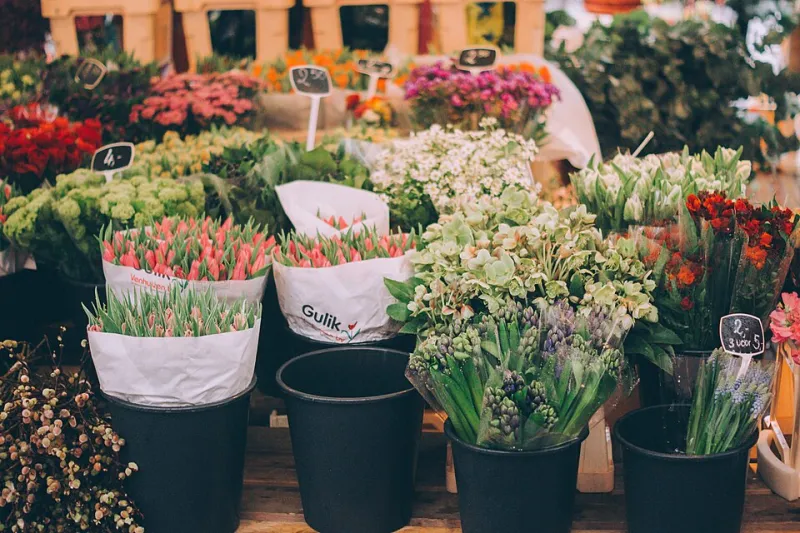
That means heat and scent over subtlety. Deep reds, burnt oranges, anything with a bit of shine to the petal. Hyacinths and stocks earn their keep because you smell them before you see them, which in a windowless room is half the battle won. Keep the vessel small and weighted — a loo arrangement that gets knocked by a coat or a handbag is a arrangement that ends up in the mop bucket.
The Church Porch: A Masterclass in Scale
Church flowers are the great proving ground of British arranging, and the porch is its most brutal exam hall. Draughts howl through those old doors. Light levels swing from gloomy to blinding. And the vessel is almost always wrong: a Victorian urn, a misused milk churn, something donated in memory of a warden long departed.
The trick, veteran arrangers told us, is to stop fighting the churn and let it do the talking. A milk churn wants a big, loose, triangular armful of material — branches first, then the filler, then a handful of focal blooms positioned at eye level and no higher. Think September hedgerow: dogwood,elderberries, a few late roses, all wedged on a chicken wire mound rather than foam. The churn's own patina does the styling for you.
Draughty porches demand foliage with staying power. Pittosporum, eucalyptus, conifer — anything that holds water in its leaf. Delicate umbels will look like they've been through the wash by Sunday's second service.
The Village Hall: Where You Learn to Work Fast
If the church teaches patience, the village hall teaches speed. Every florist who's ever done the flowers for a whist drive, an amateur dramatics production or the WI's annual meeting knows the drill: you get an hour, folding tables, and a water supply at one end of the building only.
The professionals' advice here is unromantic but sound: prep everything at home. Condition your stems overnight, pre-tape your chicken wire into your vessels, and arrive with buckets sorted by height. Village hall arrangements live or die by logistics, not artistry.
And the strip lighting? Embrace it. Halls with flat, unglamorous light actually favour bold, simple masses of colour — a bucket of sunflowers, a heap of dahlias — over the whispery, textural work that photographs beautifully in daylight and vanishes entirely under a fluorescent tube.
The Fete Jar Stall: Floristry at Its Most Honest
Finally, the school fete. Here flowers are sold by the jam jar, priced in coins, and judged by children and grandmothers — the two most honest audiences in Britain.
The lesson of the fete jar is restraint. One good stem of something home-grown — a cosmos, a sweet pea, a snapdragon — in a clean jar with a ribbon tied by a Year 4 pupil will outsell a fussy mixed bunch every time. When we teach beginners at the school, this is often where their instinct is at its best, before they've learned to overthink. One stem, chosen with love, is an arrangement.
Why It Matters
There's a thread running through all of these places, and it isn't skill or budget. It's service. The women (and it is, historically, mostly women — though that's changing, and about time) who've done the church flowers for forty years will tell you they're "just keeping it going." They are, in fact, the reason half of rural Britain encounters fresh flowers at all.
So here's our suggestion: next time you're arranging, take one arrangement out of your comfort zone. Not for the table you'll photograph. For the porch, the snug, the hall. Use what's in the garden, work fast, and don't expect applause.
The flowers will do their quiet work anyway. They always have.